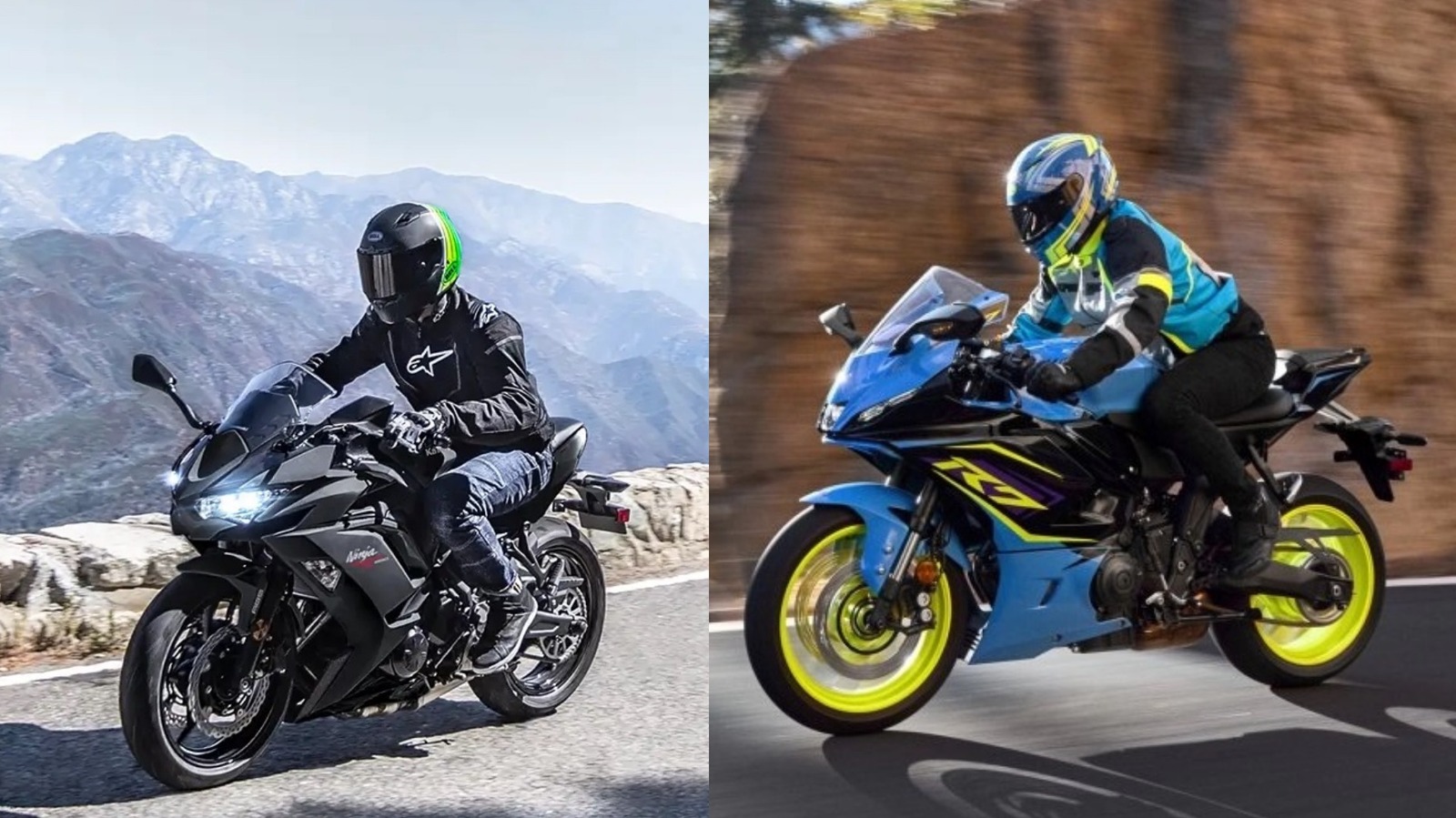
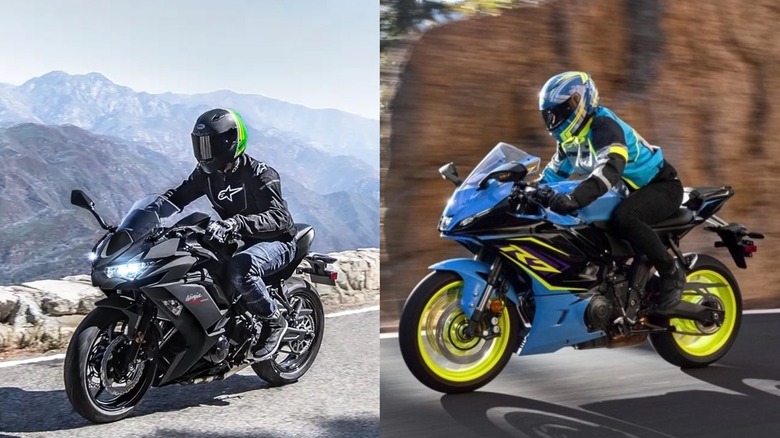
 Kawasaki/Yamaha
There's a wide variety of available sport bikes these days. From basic, low-displacement single-cylinder bikes all the way up to screaming four-cylinder superbikes, there's a full-fairing motorcycle for everybody. Two notable bikes you might land on if you're looking for something affordable and quick will likely be the Yamaha R7 and the Kawasaki Ninja 650. Both motorcycles are strong choices for middleweight sport bikes with a bit of performance on tap.
The Yamaha R7 has a pretty impressive top speed, with some riders reportedly reaching as high as 130 mph during all-out sprints. The Kawasaki Ninja 650 is ever-so-slightly slower at the top end, with a top speed of around 125 mph. So, if you've got a wide-open runway, two riders of equal weight, and an even start, the Yamaha is indeed faster than the Kawasaki. But only barely, though, and these bikes are very close when it comes to topped-out performance.
It makes sense that the two would be pretty evenly matched. They're similar in size, engine configuration, and power output. The R7 has a claimed curb weight of 417 pounds, which is relatively close to the Ninja 650's claimed 425 pounds. The R7 uses a 689cc twin-cylinder engine known as the CP2. It puts out 72 hp and 50 lb-ft of torque. The Kawasaki also has a two-cylinder engine, but it's a bit smaller at 649cc. It produces 67 hp and 48.5 lb-ft, making the Ninja 650 just a tad bit heavier and slightly less powerful.
Comparing features and specs
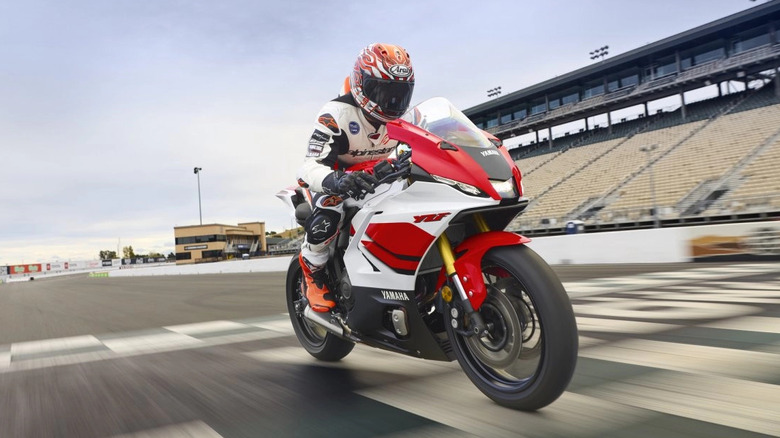 Yamaha
If you're in the market for one of these two bikes, choosing between the Yamaha R7 and the Kawasaki Ninja 650 might come down to more than top speed, so here are some more important distinctions that may help you choose. First is efficiency. Kawasaki doesn't list fuel economy for the Ninja 650, but Yamaha claims an impressive 59 mpg. Riders report similar fuel economy with the Ninja 650 and the Kawi wins the fuel capacity battle, with 4.0 gallons of space in the tank, while the Yamaha has a slightly smaller 3.7-gallon tank.
If you're looking for a bike that will accommodate shorter riders, the Kawasaki wins there too, with a 31.1-inch seat height compared to the Yamaha's 32.7-inch height. Both bikes get dual front brake discs of almost identical sizes (some less-expensive bikes only offer one brake disc up front), so braking performance will likely be similar between the two. Both motorcycles use six-speed manual transmissions with assist and slipper clutches.
Tire sizes are slightly different, with the Yamaha having a slight advantage. Up front, both bikes use 120/70x17 tires wrapped around 17-inch wheels. In the rear, the Ninja has a slightly narrower 160/60x17 tire, while the R7 runs a 180/55x17. That means the Yamaha has an extra 20mm of width on the rear tire, and while it's not exactly a one-to-one comparison, wider rear tires typically translate to higher handling limits.
What's the price difference?
 Kawasaki
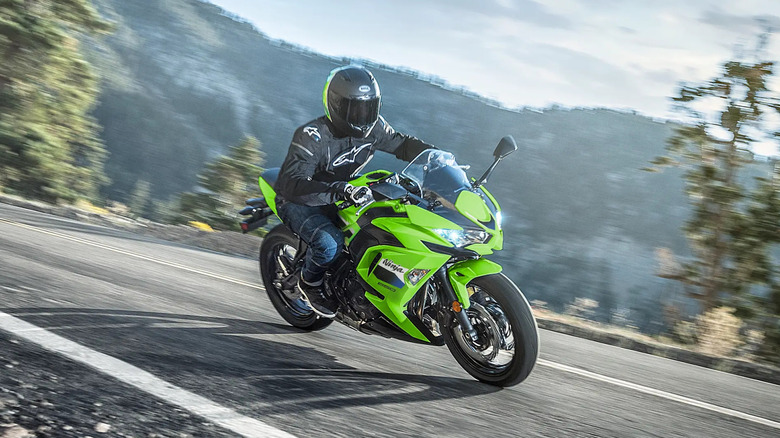
The Yamaha may be faster than the Kawasaki, but it's also significantly more expensive. The starting price for a 2026 Kawasaki Ninja 650 without ABS is $8,284 (including $685 destination fee). Add ABS to the equation, and that number goes up to $8,884. The 2026 Yamaha R7, which comes standard with ABS, has a starting price of $10,074 (including $675 destination fee). The 2026 R7 has been refreshed with some new electronics and chassis updates, so it's definitely appealing, but it's a big jump in price for such similar performance and features.
The Yamaha does have some nice touches like integrated turn signals and more modern styling, but those are likely style choices that will be preferred by some riders but shunned by others. The biggest difference between the bikes — at least, one that justifies the price — is suspension.
Kawasaki's Ninja 650 offers a basic front suspension setup with no adjustment, while the rear only offers adjustable preload. Meanwhile, the Yamaha R7 has adjustable preload, rebound, and compression for its front and rear suspension. For comfort and performance riding, those are significant upgrades that will likely make it a bike more suited for quick riding. So, which bike you choose will likely come down to the riding you do.