- Home
Edition
Africa Australia Brasil Canada Canada (français) España Europe France Global Indonesia New Zealand United Kingdom United States Edition:
Global
Edition:
Global
- Africa
- Australia
- Brasil
- Canada
- Canada (français)
- España
- Europe
- France
- Indonesia
- New Zealand
- United Kingdom
- United States
Academic rigour, journalistic flair
 A mural on the wall of a Kyiv apartment building depicts Saint Javelin, an internet meme and fictional character, cradling the FGM-148 Javelin anti-tank weapon that the Ukrainian army used against Russian troops, in February 2024. Saint Javelin was born as a meme and became a symbol of resistance against Russia.
(AP Photo/Efrem Lukatsky)
Ctrl-alt-defy: How Ukrainians have used memes to counter Russia’s propaganda machine
Published: December 2, 2025 2.50pm GMT
Michel Bouchard, University of Northern British Columbia
A mural on the wall of a Kyiv apartment building depicts Saint Javelin, an internet meme and fictional character, cradling the FGM-148 Javelin anti-tank weapon that the Ukrainian army used against Russian troops, in February 2024. Saint Javelin was born as a meme and became a symbol of resistance against Russia.
(AP Photo/Efrem Lukatsky)
Ctrl-alt-defy: How Ukrainians have used memes to counter Russia’s propaganda machine
Published: December 2, 2025 2.50pm GMT
Michel Bouchard, University of Northern British Columbia
Author
-
 Michel Bouchard
Professor of Anthropology, University of Northern British Columbia
Disclosure statement
Michel Bouchard does not work for, consult, own shares in or receive funding from any company or organisation that would benefit from this article, and has disclosed no relevant affiliations beyond their academic appointment.
Partners

University of Northern British Columbia provides funding as a member of The Conversation CA.
University of Northern British Columbia provides funding as a member of The Conversation CA-FR.
View all partners
DOI
https://doi.org/10.64628/AAM.7dwgmttmd
https://theconversation.com/ctrl-alt-defy-how-ukrainians-have-used-memes-to-counter-russias-propaganda-machine-270767 https://theconversation.com/ctrl-alt-defy-how-ukrainians-have-used-memes-to-counter-russias-propaganda-machine-270767 Link copied Share articleShare article
Copy link Email Bluesky Facebook WhatsApp Messenger LinkedIn X (Twitter)Print article
As Russian tanks rolled towards Kyiv in February 2022, a quick Russian victory seemed assured. But as Ukrainian soldiers fought off Russian invaders, Ukrainian netizens launched waves of memes to provide hope to a nation under existential threat.
These memes often mocked Russian hubris and incompetence, drawing upon news and online clips as fodder to attack Russian propaganda.
One early meme taunted Russia after Ukrainians changed road signs to confuse the military convoys. The memes show a road sign indicating that the invaders should go straight and “go fuck yourself,” turn left to “go fuck yourself again” and head “to Russia to go fuck yourself.”
Another meme involved the young Ukrainian Border Guard at Snake Island, assailed by the Russian battleship the Moskva. The final words radioed to the enemy were: “Russian warship, go fuck yourself.” This phrase quickly became a meme, a shirt, and — just a few weeks later — a commemorative stamp issued by the Ukrainian post office.
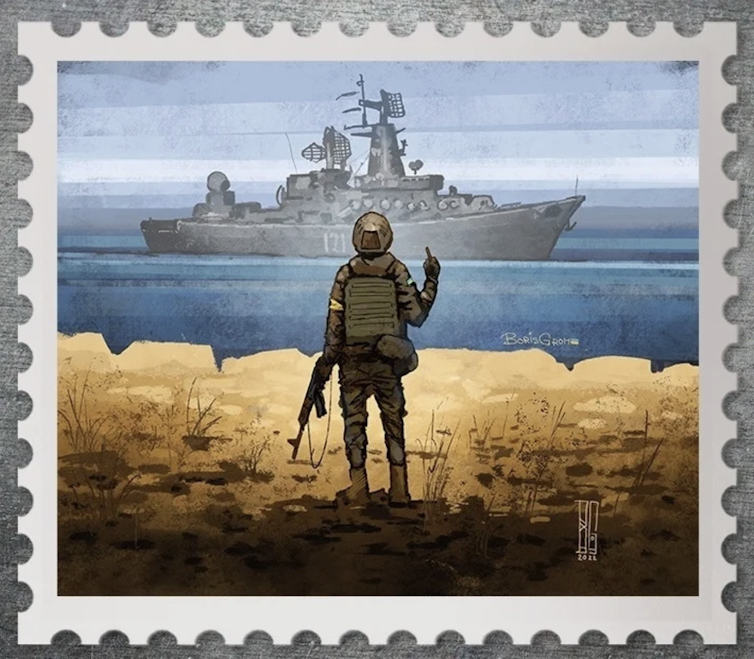 A Ukrainian postage stamp commemorating a Ukrainian Border Guard’s response to a Russian battleship at Snake Island.
(Ukrposhta)
A Ukrainian postage stamp commemorating a Ukrainian Border Guard’s response to a Russian battleship at Snake Island.
(Ukrposhta)
Memes and genes
The term “meme” was coined by evolutionary biologist Richard Dawkins in 1976 to describe “a unit of cultural transmission or a unit of imitation.”
He based it on the Greek word mimeme (something imitated). It was meant to parallel the biological concept of a gene — both the meme and the gene seek to replicate themselves and, if successful, are widely disseminated. They can also mutate, taking on new meanings as they evolve.
Memes came of age on social media platforms like Twitter, now X. They usually combine iconic images or short videos with pithy text to create humorous digital cultural creations circulated on social media. Much like the traditional editorial cartoons, they often offer social and political commentary on current events. Still, they are much more anarchic, as anyone can create and share memes, hoping they will go viral.
Memes are invariably highly symbolic and often draw in disparate elements from history and current events.
In one Ukrainian meme highlighting karmic retribution, a soldier and a dog watch the sinking Moskva as the dog cries out: “This is for my doghouse.” This meme refers to a photo circulated online that showed a doghouse perched on a Russian tank loaded with goods pillaged from Ukrainian households. The meme satirically highlighted Russian looting and tied it to the sinking of the Russian warship.
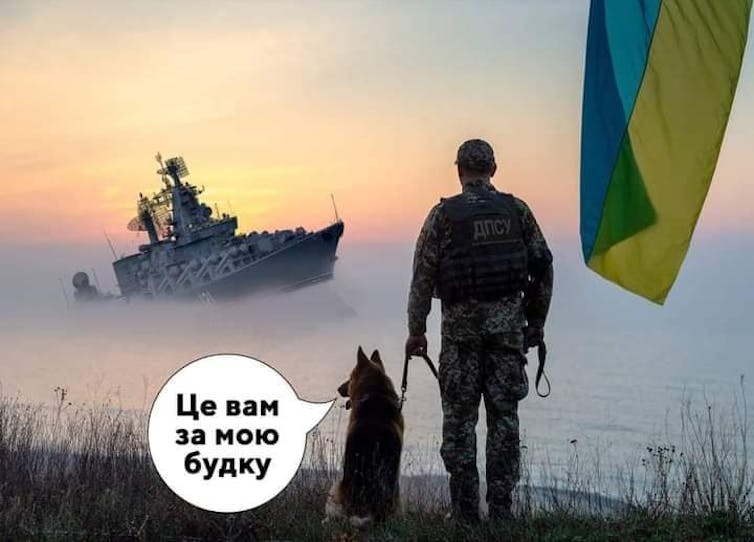 Mocking the sinking Russian warship Moskva, the dog calls out: ‘This is for my doghouse — in other words, karmic payback for Russian pillaging, looting and terror.
(Facebook)
Mocking the sinking Russian warship Moskva, the dog calls out: ‘This is for my doghouse — in other words, karmic payback for Russian pillaging, looting and terror.
(Facebook)
Ukrainian meme crusaders aim to counter Russian propaganda that justified Russia’s invasion. These propaganda efforts include paid detractors in Russian troll factories, as well as Russian and foreign vatniks — jingoistic proponents of Russian propaganda parroting unquestioningly what is put forward by Russian political and military leaders.
The term dates back to the 1960s, when grey cotton-wool jackets were issued to Soviet soldiers. The modern-day vatnik has been depicted disparagingly by Russian artist Anton Chadski as a patched-up hand with a black eye, a red nose and missing teeth. The image circulated widely on Russian social media and became prominent during the preliminary Russian invasion of Crimea in 2014.
The role of NAFO
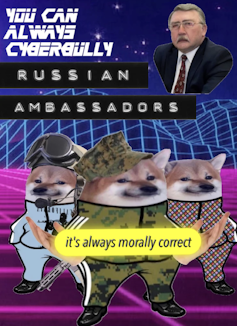 A NAFO meme.
(NAFO)
A NAFO meme.
(NAFO)
One of the most prominent and high-profile online communities of pro-Ukrainian keyboard warriors is the North Atlantic Fella Organization (NAFO/OFAN). It’s an internet meme and social media movement dedicated to battling propaganda and disinformation about the 2022 Russian invasion of Ukraine. It floods the social media posts of Russian officials, propagandists and vatniks with memes.
NAFO “fellas” use avatars depicting Shiba Inu dogs in various dress and poses. It has grown to tens of thousands of fellas with no set leadership, but all guided by the catchphrase “see a fella, follow a fella.”
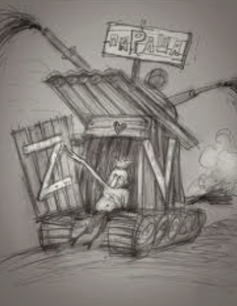 A meme of Putin in an outhouse.
(Telegram)
A meme of Putin in an outhouse.
(Telegram)
Memes like those created and circulate by NAFO also serve to insult Russia, presenting the nation as an outhouse, the army as inept and the Russian soldier as “orcs,” a fictional race of brutal and aggressive humanoids famously depicted in J.R.R. Tolkien’s Middle Earth.
In one meme, a cloven-hooved, crowned Vladimir Putin rides an outhouse tank spewing filth. Above him, the Russian word paRasha is written, which means a prison outhouse seat and is also used to signify nonsense, or simply bullshit. The “Rasha” is capitalized, playing on the Russian pronunciation of the English word Russia.
Read more: Why leaders who bullshit are more dangerous than those who lie
Latest memes
Ukraine-focused meme-making continues. Memes have emerged mocking U.S. President Donald Trump’s 28-point peace plan.
In one, there is a massive American flag and Trump in the background; the plan is presented as a 28-component Trojan horse for Ukraine.
Read more: Peace in Ukraine? Believe it when you see it, especially if Russian demands are prioritized
Ukrainian aren’t just focused on Russia — they also challenge Ukrainian leaders and officials. In a recent meme, a pair of Ukrainian state operatives note: “And (Steve) Witkoff’s tapes are much more interesting than Mindich’s tapes…”
This is a double-barrelled jab. It refers to the 1,000-plus hours of secret recordings that were made during the explosive investigation of Ukrainian-Israeli entrepreneur Tymur Mindich’s alleged $100-million Ukrainian energy sector kick-backs, and revelations that Wirkoff, Trump’s envoy in peace talks, was advising Russian officials.
Ongoing Ukrainian memes are a testament to Ukraine’s continuing resistance to Russia, even when outsiders like Trump tell them they “have no cards” to play and that they should capitulate to Russia. They are a powerful force in contemporary Ukrainian nationalism.
Ukrainian scholar Daria Antsybor, a folklorist and anthropologist, co-authored this piece.
- Social media
- Memes
- Richard Dawkins
- Vladimir Putin
- Russian propaganda
- Volodymyr Zelensky
- Ukraine invasion 2022
Events
Jobs
-
 Senior Lecturer, Clinical Psychology
-
University Lecturer in Early Childhood Education
-
Case Specialist, Student Information and Regulatory Reporting
-
Lecturer in Paramedicine
-
Associate Lecturer, Social Work
 Senior Lecturer, Clinical Psychology
 University Lecturer in Early Childhood Education
 Case Specialist, Student Information and Regulatory Reporting
 Lecturer in Paramedicine
 Associate Lecturer, Social Work
- Editorial Policies
- Community standards
- Republishing guidelines
- Analytics
- Our feeds
- Get newsletter
- Who we are
- Our charter
- Our team
- Partners and funders
- Resource for media
- Contact us
-
-
-
-
Copyright © 2010–2025, The Conversation