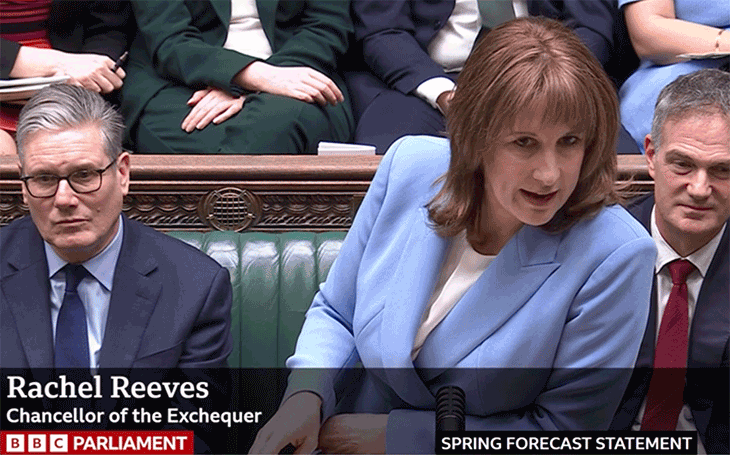
To the relief of the housing industry, Rachel Reeves used her Spring Statement to defend her record on economic stability rather than introduce any new measures.
According to Reeves, the Government has the right economic plan. She says inflation, borrowing and debt interest are all falling while living standards and GDP per head are rising and insists that easing inflation is central to reducing pressure on households and the cost of living.
Figures from the Office for Budget Responsibility (OBR) that were released to coincide with the statement predict inflation will fall from 3.4% in 2025 to 2.3% in 2026, returning to the 2% target in late 2026 – earlier than forecast in November.
Growth, though, was downgraded for 2026 to 1.1% from 1.3%, and unemployment is expected to peak at 5.3% this year. Borrowing, on the other hand, is forecast to be nearly £18bn lower than predicted, and Reeves’ fiscal headroom has increased from £21.7bn to almost £24bn.
Significant impact
However, the OBR points out that its forecasts were finalised as the conflict with Iran was escalating and warns that the situation in the Middle East could have “very significant impacts on the global and UK economies”.
As a result of the conflict, UK wholesale gas prices have surged amid threats to shipping and attacks on production facilities, increasing the risk of higher inflation and adding renewed pressure on the cost of living. Government bond yields and swap rates are also now on the rise, and they, in turn, could push up mortgage costs.
The Opposition, as you would expect, refuted Reeves’ claims, with Shadow Chancellor Mel Stride comparing her to a “dodgy estate agent” standing in a wreck of a building trying to convince people to “look at the potential.”
Industry reacts

Colleen Babcock, Head of Partner Marketing, Rightmove
“After the long build‑up to November’s Autumn Budget, which was full of near‑daily rumours about tax and policy changes, it’s been reassuring to see a much calmer run‑up to today’s Spring Forecast. It was always expected to be lower‑key, and the lack of headline‑grabbing announcements should help give movers more confidence and certainty right now.
“Looking ahead to the Autumn Budget, which is the government’s big opportunity for policy change this year, we’d really like to see stamp duty properly looked at. The current bandings haven’t kept up with house prices, and as a result, less than half of homes in England are now stamp‑duty free to first-time buyers, falling to just one in ten homes in higher‑priced regions like London. For most movers, the tax is unavoidable, and it can be a real deterrent, particularly for those at the top of chains considering a downsized move.
“With around seven or eight months to go until the Autumn Budget, there’s time for the government to give some serious thought about how the system could be improved. That could mean a more regionalised approach, higher zero‑rate thresholds, spreading payments over a longer period, or even scrapping stamp duty altogether. In its current form, stamp duty remains a major barrier to movement, which isn’t good for would-be buyers and sellers, or for the wider economy.”

Jason Tebb, President of OnTheMarket:
“Today’s Spring Budget was as low‑key as many of us were hoping for.
“After the turbulence surrounding the Autumn Budget, a continued period of clarity and certainty is now what the market needs more than ever.
“This is certainly a step in the right direction to restoring a sense of stability and rebuilding the confidence among buyers and sellers that drives market momentum.”
Jeremy Leaf, north London estate agent and a former RICS residential chairman:

“The need to improve economic growth and address rising unemployment is probably even more important now than it was at the time of last November’s Budget, but the Chancellor failed to offer much prospect of change.
“While there has been less speculation about tax rises and spending cuts this time around, the Chancellor also hasn’t delivered any encouragement for first-time buyers, who are the engine room of the housing market and enable transactions to be unlocked further up chains. There was nothing in terms of stimulating more new housing or any detail as to how she plans to increase transactions, which are not only good for the property industry but also job and social mobility, as well as keeping house prices in check.
“While the spring forecast is unlikely to choke off recent increases in home buyer and seller confidence, what happens in the Middle East – with its potential to increase inflation and keep interest rates higher for longer – may have more of an impact.”

Paul Ebbs, Divisional Managing Director at Independent housebuilder, Dandara:
“The Spring Statement may not be designed to grab headlines, but for those of us building homes, stability is exactly what the market needs. In uncertain economic times, consistency in fiscal policy, planning direction and forward forecasts gives businesses the confidence to invest, hire and deliver.
“That stability, however, must translate into action on the ground. Planning reform and steady economic messaging are welcome, but if councils remain constrained by funding and capacity pressures, delays will continue to hold back delivery. Certainty only works if it results in decisions being made and sites progressing.
“With the economy regaining momentum, the priority now should be turning confidence into construction. A clear, multi-year outlook on investment and planning certainty would provide a strong foundation for sustained housebuilding.
“But stability alone will not stimulate demand. To truly get the market moving again, we need targeted measures that support buyers and unlock transactions, whether that is a renewed form of Help to Buy or a comparable scheme that gives first-time buyers the confidence to step forward.
“If stability is the message from the Chancellor, the next step must be ensuring that stability delivers homes on the ground.”

Tim Sargeant, Chairman at developer City & Country:
“The 2026 Spring Statement was a quiet affair, but I can’t help but think that the Chancellor has missed an opportunity to use her platform to address housing, given the value that it holds both politically and culturally. Elsewhere in Europe, housing is regarded as essential infrastructure that drives the economy and supports a healthy and happy populace. Pair that with the dynamism and innovation that Britain is best known for, and we could quite easily create a housing model that is fit for purpose.
“I want to see more from the Government around increasing delivery and encouraging a strong but stable market. Growth, a stable workforce and supply chain, and reduced barriers to delivery should be at the top of the agenda. Instead, we have been subject to decades of mounting bureaucracy that ultimately ties up development while increasing costs.
“Builders are already paying enormous taxes each year, around 32% of the sales value of every home they build, not including CIL and Section 106 agreements. This cements what we do as essential infrastructure. In return, Government must change its approach and remove hurdles to development to speed up sales volumes. For buyers, moving house is often more of a trauma than it is worth. Reforming Stamp Duty would help to resolve this and encourage sustained investment in the housing market.”

Simon Cox, CEO of independent land agency Walter Cooper:
“What the market needs above all else is more clarity and better decision making. Today’s Spring Statement did little to reassure on that front. The housing sector is already under immense pressure from a land and delivery perspective, and increased taxation in previous Budgets has exacerbated that concern.
“If the Government is serious about its growth strategy, it must create a policy and operating environment with a long-term strategy that encourages sector investment rather than deters it. Land owners and developers want to build new homes and create a pipeline of viable land, but without clearer direction and a more efficient planning system, the current approach is not conducive to a healthy and thriving economy.”

Sanjay Joshi, Director of Lawsons & Daughters:
“While no major housing announcements were expected as part of the Spring Statement, the stability that comes with that is welcome after a tumultuous Autumn Budget. However, the market still needs reassurance as confidence among buyers and sellers is only just beginning to recover after a volatile period.
“Support for first-time buyers remains essential, as they help keep the market moving and unlock activity across the wider housing chain. Landlords also play a vital role in providing rental homes and maintaining supply.
“With significant legislative changes on the horizon, including the Renters’ Rights Bill and evolving energy efficiency requirements, clarity will be important to ensure continued confidence and investment across the sector. Protecting confidence across all parts of the market will be key to sustaining activity in the months ahead.”
The post REACTION: Low-key Spring Statement overshadowed by Middle East conflict appeared first on The Negotiator.