- Home
Edition
Africa Australia Brasil Canada Canada (français) España Europe France Global Indonesia New Zealand United Kingdom United States Edition:
Global
Edition:
Global
- Africa
- Australia
- Brasil
- Canada
- Canada (français)
- España
- Europe
- France
- Indonesia
- New Zealand
- United Kingdom
- United States
Academic rigour, journalistic flair
 A young voter walks past Elections Canada signage on election day on April 28, 2025 in Halifax.
THE CANADIAN PRESS/Darren Calabrese
Encouraging young people to vote requires understanding why they don’t
Published: November 26, 2025 2.24pm GMT
Christopher Alcantara, Craig Mutter, Laura Stephenson, Western University
A young voter walks past Elections Canada signage on election day on April 28, 2025 in Halifax.
THE CANADIAN PRESS/Darren Calabrese
Encouraging young people to vote requires understanding why they don’t
Published: November 26, 2025 2.24pm GMT
Christopher Alcantara, Craig Mutter, Laura Stephenson, Western University
Authors
-
 Christopher Alcantara
Professor of Political Science, Western University
-
Craig Mutter
Graduate Student, Political Science, Western University
-
Laura Stephenson
Professor of Political Science, Western University
Disclosure statement
Christopher Alcantara receives funding from Max Bell Foundation for this research report.
Craig Mutter receives funding from Max Bell Foundation for this research.
Laura Stephenson receives funding from Max Bell Foundation for this research.
Partners

Western University provides funding as a member of The Conversation CA-FR.
Western University provides funding as a member of The Conversation CA.
View all partners
DOI
https://doi.org/10.64628/AAM.k4f64favn
https://theconversation.com/encouraging-young-people-to-vote-requires-understanding-why-they-dont-270015 https://theconversation.com/encouraging-young-people-to-vote-requires-understanding-why-they-dont-270015 Link copied Share articleShare article
Copy link Email Bluesky Facebook WhatsApp Messenger LinkedIn X (Twitter)Print article
Around the world, political institutions are under threat and democracy hangs in the balance. Deepening political divisions, political apathy and the rise of opportunistic populist leaders have all contributed to widespread democratic backsliding and a rise in authoritarianism.
Meeting this challenge requires active and engaged citizens. In Canada, there’s a strong sense that civic engagement is on the decline, especially among young people. Recent research commissioned by the Max Bell Foundation — a charity that works to improve educational, health and environmental outcomes for Canadians — suggests that the real story may be more complex.
Our research on political engagement has found that while today’s young Canadians are participating less in conventional political activities, they are increasingly active in other less traditional ways. How do we encourage youth to engage in all forms of civic life?
Ballots versus boycotts
Our analyses of Elections Canada voting data and survey data, collected through the Canada Election Study and Democracy Checkup projects, clearly illustrate that young people differ from older Canadians in how they participate in civic and political life.
Canadians between the ages of 18 and 34 are less likely to vote than those in other age cohorts and had the steepest decline in turnout from 2015 to 2021, when fewer than half of eligible young Canadians voted.
Young people are generally less knowledgeable and politically informed than older adults.
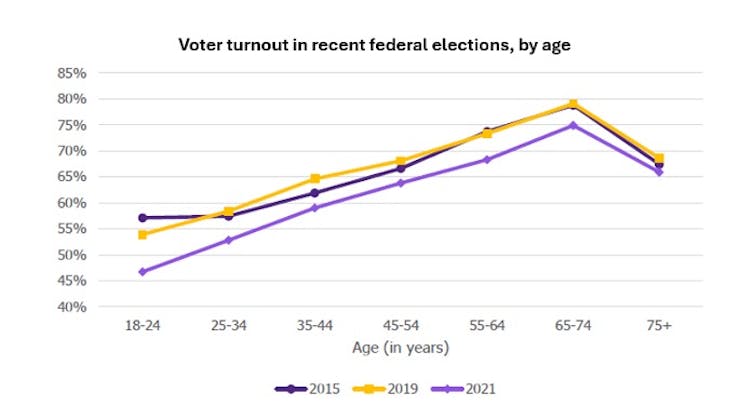 Voter turnout numbers in recent Canadian federal elections by age.
(Elections Canada)
Voter turnout numbers in recent Canadian federal elections by age.
(Elections Canada)
At the same time, young Canadians are at the forefront of discussing politics online, following politicians on social media and mobilizing their peers through digital platforms. They are more likely to take part in protests, petitions and political consumerism — from boycotts to buycotts — and to volunteer with community organizations and political campaigns at higher rates than other age groups.
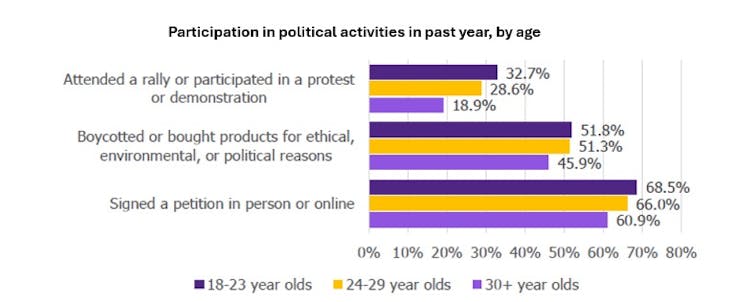 Data on levels of political participation by age.
(Democracy Checkup surveys)
Data on levels of political participation by age.
(Democracy Checkup surveys)
The real story isn’t that youth don’t care or aren’t political. It’s that they are turning away from conventional, formal participation in favour of alternative ways of sharing and expressing their views.
Explaining changing participation norms
Our analysis suggests that younger Canadians differ from their older counterparts across key factors that shape whether and how they participate.
Many young Canadians cite a lack of time as a barrier to engagement, have lower levels of political knowledge, report slightly lower levels of interest in politics and struggle to make the connection between politics and the issues they care about.
Our work also suggests that youth are noticeably less likely to see civic participation like voting as a duty, and they’re much more likely to be influenced by whether they believe their participation will make a difference.
This presents a particular challenge, because youth also tend to express higher levels of skepticism that their participation matters.
One final surprising finding is that more attention may need to be paid to understanding how political polarization affects youth. Young people may be increasingly put off from politics by hostility and conflict that they want to avoid.
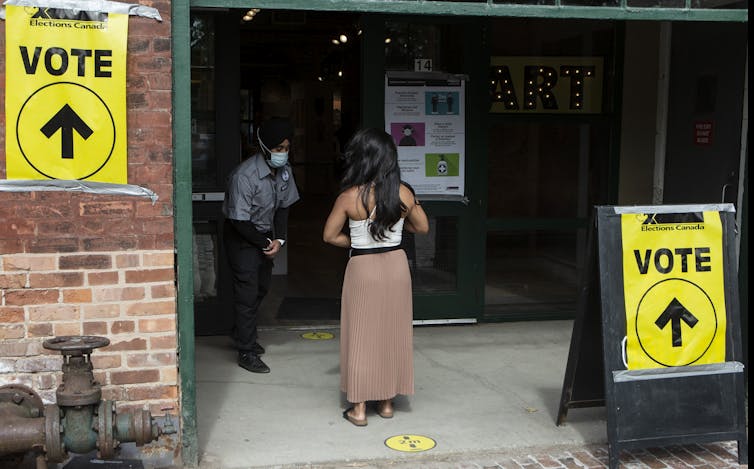 A voter queues at a polling station to cast a ballot in the September 2021 federal election in Toronto.
THE CANADIAN PRESS/Chris Young
A voter queues at a polling station to cast a ballot in the September 2021 federal election in Toronto.
THE CANADIAN PRESS/Chris Young
Civic engagement beyond election day
Youth don’t seem to be tuning out but are instead finding different ways to engage. Nonetheless, declining interest in political engagement through formal institutions represents a real concern for democracy in Canada.
So how to build upon the areas where youth are already engaging, and bring young people back into conventional forms of civic engagement like voting?
Our conversations with civil society organizations suggest that civic engagement starts with effective civic education programs in schools, while highlighting the challenges these programs face — from educator training to curriculum design and sustainability over time.
They also highlight the challenge of reaching older youth, especially those referred to as NEET by statisticians — not in employment, education or training. Our interviewees shared their own successful strategies and emphasized the importance of reaching out to youth where they are and through the media and platforms that they prefer.
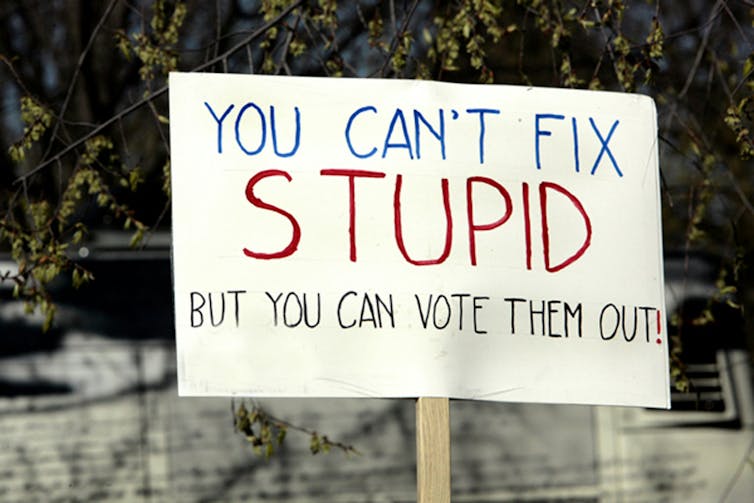 Young people express higher levels of skepticism that voting matters.
(David Trinks/Unsplash)
Young people express higher levels of skepticism that voting matters.
(David Trinks/Unsplash)
What comes next?
Democracies around the world are under pressure, and Canada is no exception. In this moment, it’s more critical than ever to pay attention to youth civic engagement.
Investing in civic education and encouraging civic participation early in life helps ensure young people have a voice in politics. But perhaps more importantly, it can also demonstrate how civic engagement can lead to change and challenge the feelings of powerlessness that drive disengagement. Youth participation helps build habits that last a lifetime and is essential to sustaining democracy for generations to come.
The future of Canadian democracy is in the hands of our youth. They must be equipped with the knowledge and the skills to shape it for the better.
- Youth vote
- Voter turnout
- Young voters
- Voter apathy
- Canadian federal elections
Events
Jobs
-
 Senior Lecturer / Lecturer, Environmental Engineering
-
Case Specialist, Student Information and Regulatory Reporting
-
Lecturer in Paramedicine
-
Associate Lecturer, Social Work
-
Lecturer, Communication Design
 Senior Lecturer / Lecturer, Environmental Engineering
 Case Specialist, Student Information and Regulatory Reporting
 Lecturer in Paramedicine
 Associate Lecturer, Social Work
 Lecturer, Communication Design
- Editorial Policies
- Community standards
- Republishing guidelines
- Analytics
- Our feeds
- Get newsletter
- Who we are
- Our charter
- Our team
- Partners and funders
- Resource for media
- Contact us
-
-
-
-
Copyright © 2010–2025, The Conversation
-in-Hochstatt-eastern-France.jpeg?width=1200&auto=webp&trim=0%2C0%2C0%2C0)