- News
Asian shares are mixed after U.S. stocks held steadier as both bond yields and bitcoin stabilized
Elaine KurtenbachWednesday 03 December 2025 06:22 GMTAsian shares are mixed as steady bond yields, rebound for bitcoin push US stocks higher
Show all 4




For free real time breaking news alerts sent straight to your inbox sign up to our breaking news emails
Sign up to our free breaking news emails
Sign up to our free breaking news emails
Email*SIGN UPI would like to be emailed about offers, events and updates from The Independent. Read our Privacy notice
Asian shares were mixed Wednesday after stocks on Wall Street held steadier as both bond yields and bitcoin stabilized.
U.S. futures rose and oil prices edged higher.
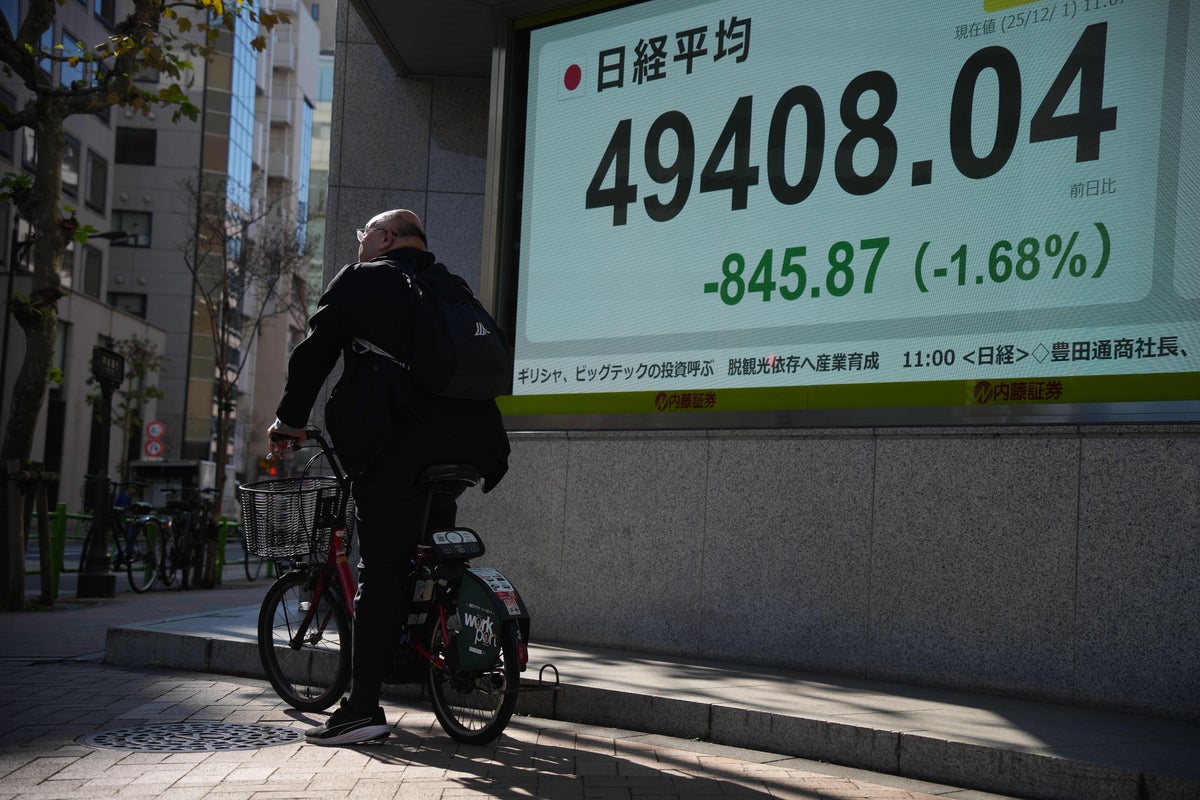
Tokyo's Nikkei 225 jumped 1.6% to 50,063.65 on big gains for technology shares like Tokyo Electron, which jumped 5.6%. Adventest, a maker of computer chip testing equipment, surged 6.9%.
Technology and telecoms giant SoftBank Group Corp. surged more than 8% following reports that its founder, Masayoshi Son, regretted having to sell shares in computer chip maker Nvidia to help pay for other investments. The company's share price sank after it announced last month that it had sold the shares for $5.8 billion.
South Korea's Kospi also got a lift from tech shares, gaining 1.2% to 4,042.40. Shares in Samsung Electronics, the country's biggest company, rose 1.8%.
But Chinese markets declined following the release of data showing weaker factory activity.
Hong Kong's Hang Seng fell 1.1% to 25,797.24, while the Shanghai Composite index shed 0.3% to 3,885.36.
Australia's S&P/ASX 200 edged 0.2% higher, to 8,595.20.
On Tuesday, the S&P 500 rose 0.2% to 6,829.37. The Dow Jones Industrial Average added 0.4% to 47,474.46, and the Nasdaq composite gained 0.6% to 23,413.67.
Boeing soared 10.1% and was one of the strongest forces lifting the S&P 500. Chief Financial Officer Jay Malave said the plane maker expects growth next year in an underlying measure of how much cash it produces.
Database company MongoDB also helped lead the market, jumping 22.2% after it delivered stronger results for the latest quarter than analysts expected.
They helped offset a 6.8% drop for Signet Jewelers, which gave a forecast for revenue in the holiday shopping season that fell short of analysts’ expectations. The jeweler said it’s expecting “a measured consumer environment.”
Another potential warning about U.S. shoppers’ strength came from the chief financial officer of Procter & Gamble, the giant behind Tide detergent and Ivory soap, whose shares slipped 1.1%.
The U.S. economy has been holding up overall, but that’s masking sharp divisions beneath the surface. Lower-income households are struggling with higher prices while richer households are benefiting from a stock market that’s within 1% of its all-time high set in late October.
In the bond market, Treasury yields calmed following their jumps the day before. The 10-year yield edged down to 4.08% from 4.09% late Monday, while the two-year yield eased to 3.51% from 3.54%.
Higher yields can drag prices lower for all kinds of investments, and those seen as the most expensive can take the biggest hit.
Monday’s climb in Treasury yields came after the governor of the Bank of Japan hinted that it may raise interest rates there soon. But hopes are still high that the Federal Reserve will cut its main interest rate when it meets in Washington next week.
The Japanese central bank is likely to raise its benchmark rate at its Dec. 19 meeting, Tan Boon Heng of Mizuho Bank in Singapore, because failing to do so could lead investors to sell off Japanese yen.
“Yet, delivering a ‘done deal’ hike may perversely deny any appreciable JPY (Japanese yen) gains, whilst boosting long-end yields,” he said in a report.
The Fed has already cut its overnight interest rate twice this year in hopes of shoring up a slowing job market. But lower rates can fan inflation, which has stubbornly remained above its 2% target.
Complicating things is the U.S. government’s earlier shutdown, which delayed reports on the job market and other areas of the economy.
In other dealings early Wednesday, bitcoin, which tumbled below $85,000 on Monday as bond yields worldwide marched higher, rose to $94,000.
U.S. benchmark crude oil edged 3 cents higher to $58.67 per barrel. Brent crude, the international standard, gained 4 cents to $62.49 per barrel.
The U.S. dollar slipped to 155.68 Japanese yen from 155.87 yen. The euro rose to $1.1645 from $1.1626.
___
AP Business Writers Matt Ott and Stan Choe contributed.